Watch Bharatanatyam in India
Introduction
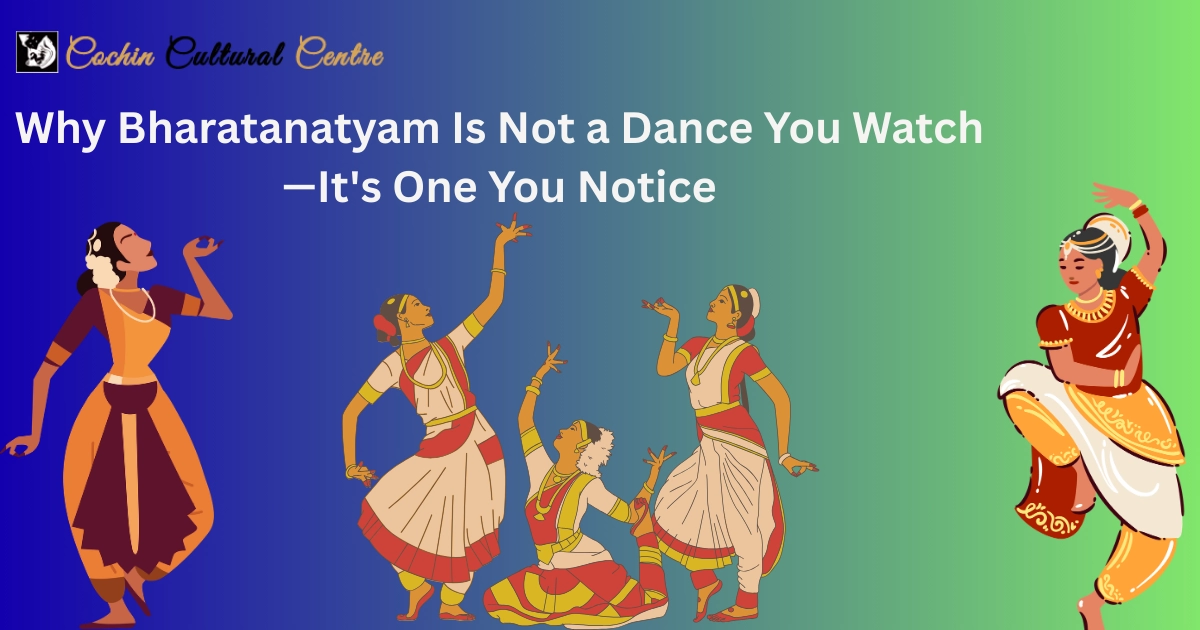
Most people “watch” dance performances. They see movements, appreciate skill, applaud politely.
But Bharatanatyam? It demands something different.
At Cochin Cultural Centre, we’ve observed a fascinating pattern: tourists who come to “watch” Bharatanatyam end up leaning forward, eyes widening, completely absorbed in details they didn’t expect to notice.
Bharatanatyam isn’t passive entertainment. It’s an invitation to truly see—to notice layers of meaning in every gesture, expression, and rhythm.
Watching vs. Noticing: The Difference
Watching is passive: Your eyes scan the stage. You take in the overall picture. It’s pleasant background.
Noticing is active: Your attention sharpens. You become aware of details—the angle of a finger, the tilt of a neck, the precise moment a foot strikes the floor.
Bharatanatyam transforms viewers into noticers.
What You’ll Notice at Cochin Cultural Centre
- Eyes That Tell Complete Stories
Bharatanatyam dancers train for years to master eye movements (drishti). You’ll notice:
- Eyes following an imaginary bird across the sky
- Glances expressing shyness, longing, or devotion
- The subtle difference between looking at a lover versus a deity
Once you start noticing the eyes, you can’t stop. They communicate entire narratives without words.
- Hands Speaking a Language
Mudras (hand gestures) aren’t decoration—they’re vocabulary. You’ll notice:
- A lotus blooming from joined fingertips
- A deer’s head formed by crossing thumbs
- The moon represented by a curved finger
Each gesture has precise meaning. Dancers combine them like sentences, creating visual poetry.
- Feet Creating Rhythms You Feel
Bharatanatyam is seen, heard, AND felt. Notice:
- The satisfying thud of bare feet on wooden floors
- Complex rhythmic patterns syncing perfectly with drums
- How the stage vibrates with each stamped sequence
The footwork isn’t background—it’s percussion.
- Every Angle Has Meaning
Nothing is accidental. You’ll notice:
- The aramandi (bent-knee position) creating geometric precision
- Triangular shapes formed by arms and torso
- Head tilts that transform defiance into devotion
This geometric precision creates visual satisfaction your brain craves.
- Facial Expressions That Shift Like Weather
The abhinaya (expressive component) showcases nuanced emotions. Notice:
- Eyebrows conveying questions without words
- Lips transitioning from smile to sorrow in seconds
- Micro-expressions revealing inner thoughts
Bharatanatyam dancers are actors as much as dancers.
- Costumes Choreographed Into Movement
At Cochin Cultural Centre, notice:
- The pleated fan opening dramatically during leg extensions
- Jewelry punctuating movements with sound and flash
- The bindi marking the focal point during head movements
The costume is part of the choreography, not separate from it.
- Music and Movement in Conversation
You’ll notice the dialogue between:
- Mridangam (drum) rhythm and footwork
- Vocal lyrics and hand gestures translating those words
- Violin phrases matched by facial expressions
Dancer and musicians aren’t just synchronized—they’re conversing.
Why “Noticing” Matters
It Makes You Present
When you notice details, you can’t multitask. You can’t think about tomorrow or mentally scroll your to-do list.
Bharatanatyam pulls you completely into the present moment—a rare gift in our distracted world.
It Trains Your Eye
After experiencing Bharatanatyam, you notice differently. You become aware of:
- How people communicate through gesture in daily life
- Rhythm in ordinary movements
- Emotional expressions you’d normally miss
It’s like upgrading your observational skills.
It’s Intellectually Satisfying
Your brain loves decoding patterns. Bharatanatyam gives your intellect something substantial:
- Symbolic gestures to interpret
- Rhythmic patterns to anticipate
- Stories told through pure movement
You leave mentally stimulated, not just entertained.
It Creates Deeper Appreciation
Once you notice the years of training behind each eye movement, the precision in every gesture, and the storytelling embedded in choreography, appreciation deepens from “that was nice” to “that was extraordinary.”
What Makes Cochin Cultural Centre Special
Expert Context: We explain what to notice before performances—key mudras, the story being portrayed, techniques to watch for.
Intimate Setting: Close enough to see facial expressions clearly, hear ankle bells distinctly, and notice subtle details larger venues obscure.
Authentic Artistry: Our Bharatanatyam dancers are classically trained artists with decades of dedication. You’re experiencing the real art form in full complexity.
Multiple Layers: First time or fifth time, you’ll notice something new. Bharatanatyam rewards repeated viewing.
What First-Time Noticers Tell Us
“I thought I was watching a dance. Then I realized I was reading a story told entirely through hands and eyes.”
“I’ve never paid such close attention to anything. It was like meditation.”
“Halfway through, I realized I was holding my breath trying to catch every detail.”
“We spent an hour afterward discussing everything we’d noticed. Still talking about it days later.”
How to Become a Noticer
Don’t try to notice everything: Pick one element per piece—hand gestures, then eyes, then footwork rhythms. Focused attention trains your noticing muscles.
Let your eye wander: Notice the musicians, costume movement, relationships between performers. Peripheral noticing enriches the experience.
Watch for repetition and variation: Bharatanatyam repeats sequences with subtle changes. Noticing these reveals the dancer’s artistic choices.
Trust your instincts: If something catches your attention, stay with it. Your instinct finds meaningful details before your mind understands why.
Why This Matters Beyond Entertainment
In our scroll-past-everything culture, we’ve lost the art of noticing. Everything is designed for passive consumption and quick distraction.
Bharatanatyam refuses this. It demands—and rewards—active attention.
At Cochin Cultural Centre, experiencing Bharatanatyam isn’t just cultural tourism. It’s practicing a valuable skill: the ability to slow down, pay attention, and notice richness that exists when you truly see.
This extends beyond performance. Once you’ve trained yourself to notice in Bharatanatyam, you notice more in life—gestures people make, rhythms in conversations, stories told through body language.
Your Invitation to Notice
Come to Cochin Cultural Centre not just to watch Bharatanatyam, but to practice the art of noticing.
Bring your curiosity. Bring your attention. Bring your willingness to engage with an art form that invites you to participate through observation.
You’ll leave having experienced something rare: a performance that makes you more aware, more present, and more attuned to the world’s details.
Book your Bharatanatyam experience at Cochin Cultural Centre. Don’t just watch dance—discover what you notice when art demands your full attention.