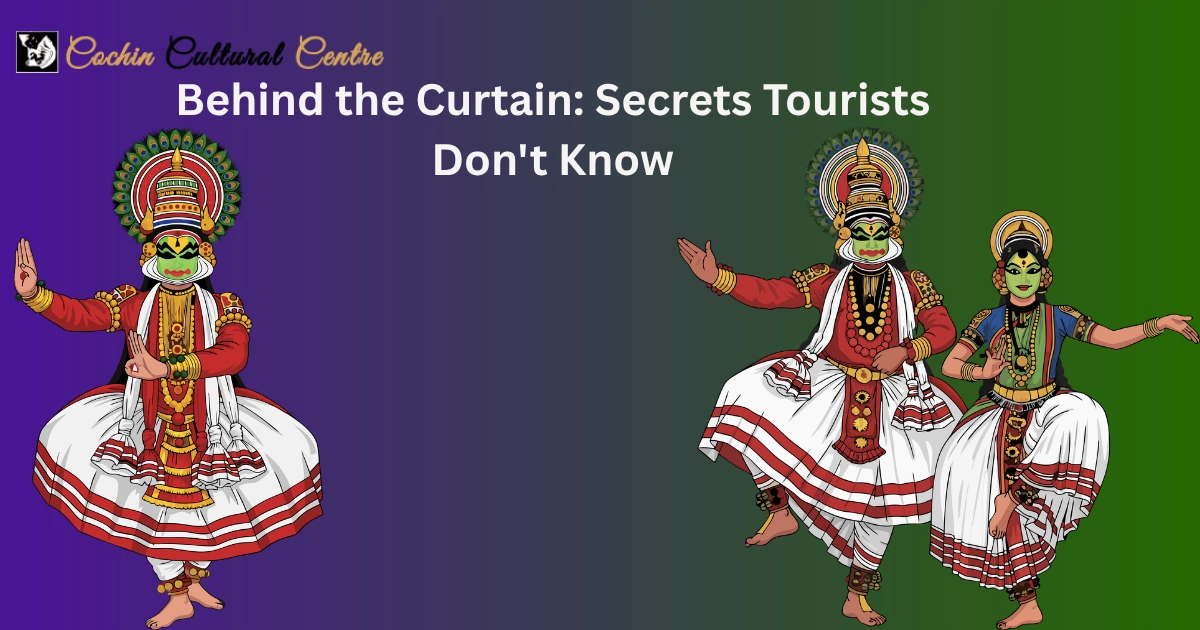
Behind the Curtain: Secrets Tourists Don’t Know
▌ The Show Starts Before You Think It Does
Most tourists walk into a Kathakali performance and sit down as the drums begin. What they miss is the extraordinary two hours that come before — the sacred, meditative ritual of transformation that turns a human being into a god, a demon, or a hero. At Cochin Cultural Centre in Fort Kochi, we invite you to arrive early. Not just because it is polite. Because the backstage makeup ceremony is, without question, one of the most astonishing things you will witness anywhere in India.
The performer sits still for two to three hours while a makeup artist builds an entirely new face from rice paste, natural pigments, and coconut oil. This is not stage makeup. This is a visual language developed over 500 years, and every colour tells you exactly who you are looking at before a single word is spoken or a single step is danced.
” The face you see on stage took longer to create than the performance itself. That is not vanity — that is devotion. “
Five Secrets That Change Everything
SECRET 1: The Eyes Are the Entire Performance — Kathakali performers train for years just to control their eye movements independently. Each roll, dart, and widening of the eye expresses a specific emotion called a Rasa. There are nine of them. Watch the eyes, not the costume.
SECRET 2: Green Means Hero — Always — Kathakali has a strict colour-coded character system. Green face = noble hero. Black patches = villain or demon. Red and black = fierce warrior. Once you know this, the story becomes instantly readable even without understanding the language.
SECRET 3: The Lamp Has a Purpose — The large brass oil lamp at the front of the stage is not decoration. It is the traditional light source Kathakali was designed to be performed under. Watching a performer’s face in lamplight, as it was meant to be seen, reveals facial expressions that modern stage lighting actually obscures.
SECRET 4: The Musicians Narrate Everything — The vocalist singing behind the performers is actually telling the entire story in Malayalam. The dancer is the visual translation of those words. If you watch carefully, you will see the performer react to each line as it is sung.
SECRET 5: Chhutty is Edible — The white border you see on the performer’s face — called Chhutty — is made primarily from rice paste and lime. It is completely natural. Watching it being built up stroke by stroke backstage is like watching sculpture come to life.
▌ Why Cochin Cultural Centre Is the Right Place
Fort Kochi has been a crossroads of cultures since the 15th century — Portuguese, Dutch, Jewish, Chinese, and British influences all left their mark on this extraordinary neighbourhood. It is fitting, then, that the finest place to encounter Kerala’s own ancient art form sits in the heart of it.
Cochin Cultural Centre is not a tourist attraction that happens to show Kathakali. It is a living institution dedicated to preserving classical standards while welcoming curious visitors from every part of the world. The performers here are trained masters. The setup allows you to watch the makeup, attend the introduction, experience the performance, and meet the artists — all in a single unforgettable evening.
Come for the secrets. Stay for the story. Leave as someone who genuinely knows Kathakali.
Frequently Asked Questions
The questions visitors ask us most — answered honestly.
Q What exactly is Chhutty and why does it take so long to apply?
Chhutty is the thick white border that frames the Kathakali performer’s face, built from rice paste and lime applied in layers that dry between each coat. It can take 45 minutes to an hour just for this one element. The full makeup process — including base colours, character patterns, and the elaborate headpiece — takes between two and three hours. Watching it applied is a genuine privilege that most visitors to Kerala never see.
Q How do I know which character is which during the performance?
Kathakali uses a strict colour-code system that has remained consistent for centuries. Green face indicates a noble, heroic character. A face with black patches signals a villain or demon. Orange and red tones indicate fierce, warrior-type characters. White is used for female roles and saintly figures. Cochin Cultural Centre always explains this colour vocabulary before the show begins, so you will recognise every character the moment they appear on stage.
Q Do I need to understand Malayalam or Indian classical music to enjoy the show?
No understanding of Malayalam or classical music is needed whatsoever. The pre-show introduction provided by Cochin Cultural Centre covers the story, characters, and key gestures. The performance itself communicates almost entirely through facial expression, eye movement, and hand gestures — a physical language that crosses every cultural boundary. Visitors from all over the world, with no background in Indian arts, consistently describe Kathakali as one of the most emotionally powerful things they have ever seen.
Q How long is a typical Kathakali performance at Cochin Cultural Centre?
The evening is structured in two parts. The makeup demonstration runs for approximately 30 to 45 minutes and is open for visitors to watch up close. The performance itself lasts around 45 minutes to one hour. Many visitors also spend time after the show meeting the artists and taking photographs. Budget around two hours from arrival to departure for the full, unhurried experience.
Q Is Kathakali appropriate for young children and elderly visitors?
Kathakali is wonderful for all ages. Young children are typically captivated by the vivid face paint, dramatic costumes, and thundering percussion — many parents say the makeup session is their children’s most talked-about memory from Kerala. For elderly visitors, the seating at Cochin Cultural Centre is comfortable and accessible. The performance space is intimate, meaning there is no bad seat in the house regardless of where you are seated.
Q Can I take photographs, and will the performers pose with me?
Photography during the makeup demonstration is very much encouraged — the images you capture will be extraordinary. During the live performance, we ask that cameras remain still and flash-free to protect the atmosphere for all guests. After the show ends, the performers are genuinely happy to pose for photographs and briefly answer questions through the centre’s staff. These post-show portraits, with the full costume and makeup still intact, are among the finest travel photographs taken anywhere in South India.
Q What should I wear and is there anything I should not do during the show?
There is no dress code for Kathakali performances at Cochin Cultural Centre — comfortable clothing suitable for an evening in Kerala is perfectly appropriate. Out of respect for the artists and fellow audience members, we ask that mobile phones be silenced during the performance and that conversations be kept for the intervals. Shoes are usually removed at the entrance to the performance space, which is standard practice at cultural venues across Kerala.
Q How far in advance should I book and where can I get tickets?
During the peak tourist season from November to March, booking two to three days in advance is advisable as shows fill quickly, especially on weekends. During other months, same-day booking is usually possible, though advance reservation always guarantees the best seats. Tickets can be arranged directly through Cochin Cultural Centre. Pricing is very accessible and represents exceptional value for the quality of a world-class classical performance.682001 • www.cochincultural.com