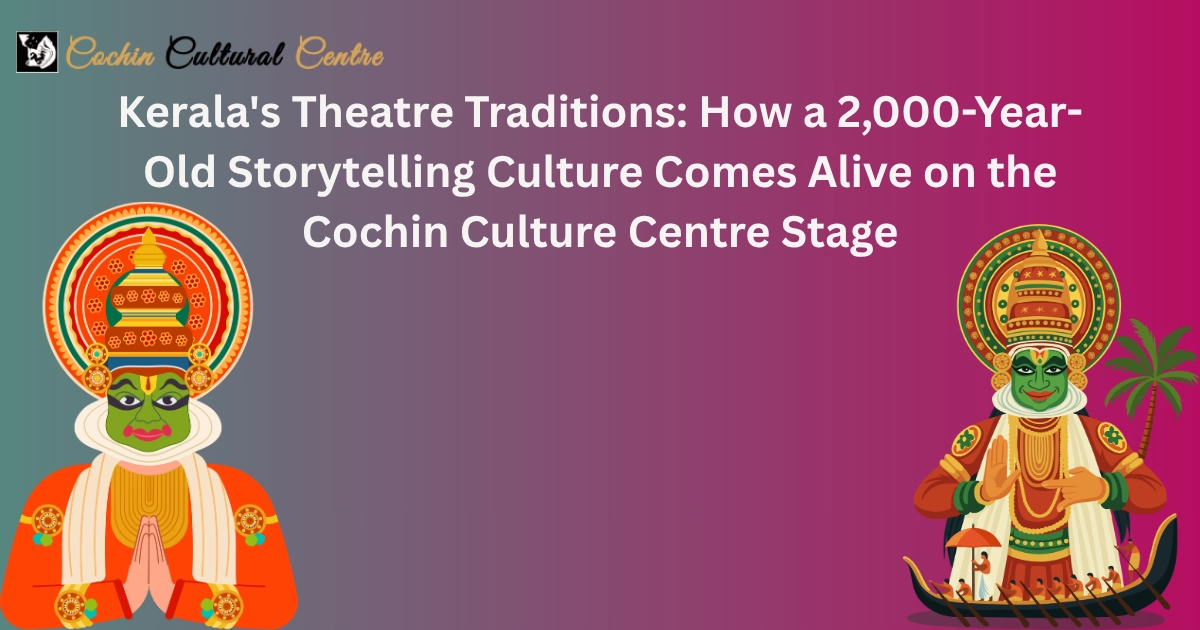
Kerala’s Theatre Traditions: How a 2,000-Year-Old Storytelling Culture Comes Alive on the Cochin Culture Centre Stage
Some stories refuse to die.
They survive invasions, colonial rule, modernisation, and the relentless churn of new entertainment. They survive because someone, in every generation, decides they are worth keeping. Worth learning. Worth performing again — tonight, in front of a live audience, with the same gestures and rhythms their great-grandparents used.
Kerala is home to some of the world’s oldest living theatre traditions. And when you sit down for a performance at Cochin Culture Centre in Fort Kochi, you’re not watching a revival or a reconstruction. You’re watching something that never stopped.
A Stage That Was Never Empty
Long before cinema, long before television, long before any screen existed to carry a story — Kerala had its stages.
Koodiyattam, recognised by UNESCO as an Intangible Cultural Heritage of Humanity, is widely considered the oldest surviving classical theatre form in the world. It dates back over 2,000 years. Performed in the ancient language of Sanskrit with elaborate costume and makeup, Koodiyattam was traditionally staged inside temple theatres called koothambalam — and the performances could last not one night but several, sometimes stretching across days as a single story unfolded.
Then came Kathakali — Kerala’s most internationally recognised performance tradition. Born in the 17th century from older forms like Krishnanattam and Ramanattam, Kathakali brought mythological storytelling to a broader audience. The green-faced heroes, the towering headdresses, the percussion that shakes the floor — all of it in service of one thing: telling a story so vividly that words become unnecessary.
And alongside these classical giants, Kerala nurtured a rich tradition of folk theatre — forms like Theyyam, Padayani, and Ottamthullal — rooted not in temples and royal courts but in village squares and community festivals. These were the people’s theatre: loud, colourful, funny, irreverent, and deeply connected to the rhythms of everyday Kerala life.
All of these traditions share one quality. They are alive. Not archived. Not academic. Alive.
What Makes Kerala’s Storytelling Tradition Unique
Theatre exists in every culture. What makes Kerala’s performance traditions genuinely extraordinary is the completeness of the language they’ve developed.
In most theatre, the actor uses voice as the primary instrument. In Kerala’s classical theatre forms, the voice is almost secondary. The real communication happens through hasta mudras — a vocabulary of hand gestures numbering in the hundreds — combined with navarasas, the nine fundamental human emotions expressed through precise facial movement. Add to this the layered symbolic meaning of costume colours, the narrative role of the percussion, and the way the performer’s entire body becomes a storytelling instrument, and you begin to understand why these traditions take years — sometimes decades — to master.
A trained Kathakali artist doesn’t just perform emotions. They have learned to physically become them. The ability to move each eye independently, to make tears appear on cue, to shift between nine emotional states in seconds — this is not talent alone. It is the product of a training system that has been refined continuously for over four centuries.
When you watch a performance at Cochin Culture Centre, you are watching the output of that system. The performer on that stage has walked a long road to stand there.
Why the CCC Stage Matters
Fort Kochi has always been a meeting point — a place where cultures arrived, exchanged, and transformed each other. It is fitting, then, that one of Kerala’s most important cultural venues sits in the middle of it.
Cochin Culture Centre brings Kerala’s classical and folk theatre traditions to visitors from across the world in a way that is both accessible and uncompromising. The performances are introduced and contextualised so that first-time audiences — whether from Tokyo or Toronto or Trivandrum — can follow the story and understand what they’re seeing. But the art itself is never simplified. The performers bring the full weight of their training to every show.
For tourists looking for authentic Kerala cultural experiences, for art lovers seeking classical Indian theatre in Kochi, and for curious travelers who want to understand what this remarkable state is actually made of — the CCC stage is the answer.
There are no screens here. No special effects. Just a performer, an ancient story, and a room full of people discovering that 2,000 years of human storytelling still has something urgent to say.
Come and Witness It Yourself
Kerala’s theatre traditions didn’t survive this long by being kept in books. They survived because audiences kept showing up.
When you take your seat at Cochin Culture Centre in Fort Kochi, you become part of that chain. You become the reason the tradition continues — one more generation of witnesses to a storytelling culture that the world cannot afford to lose.
The stage is set. The drums are warming up. The story is about to begin.
Don’t miss it.